
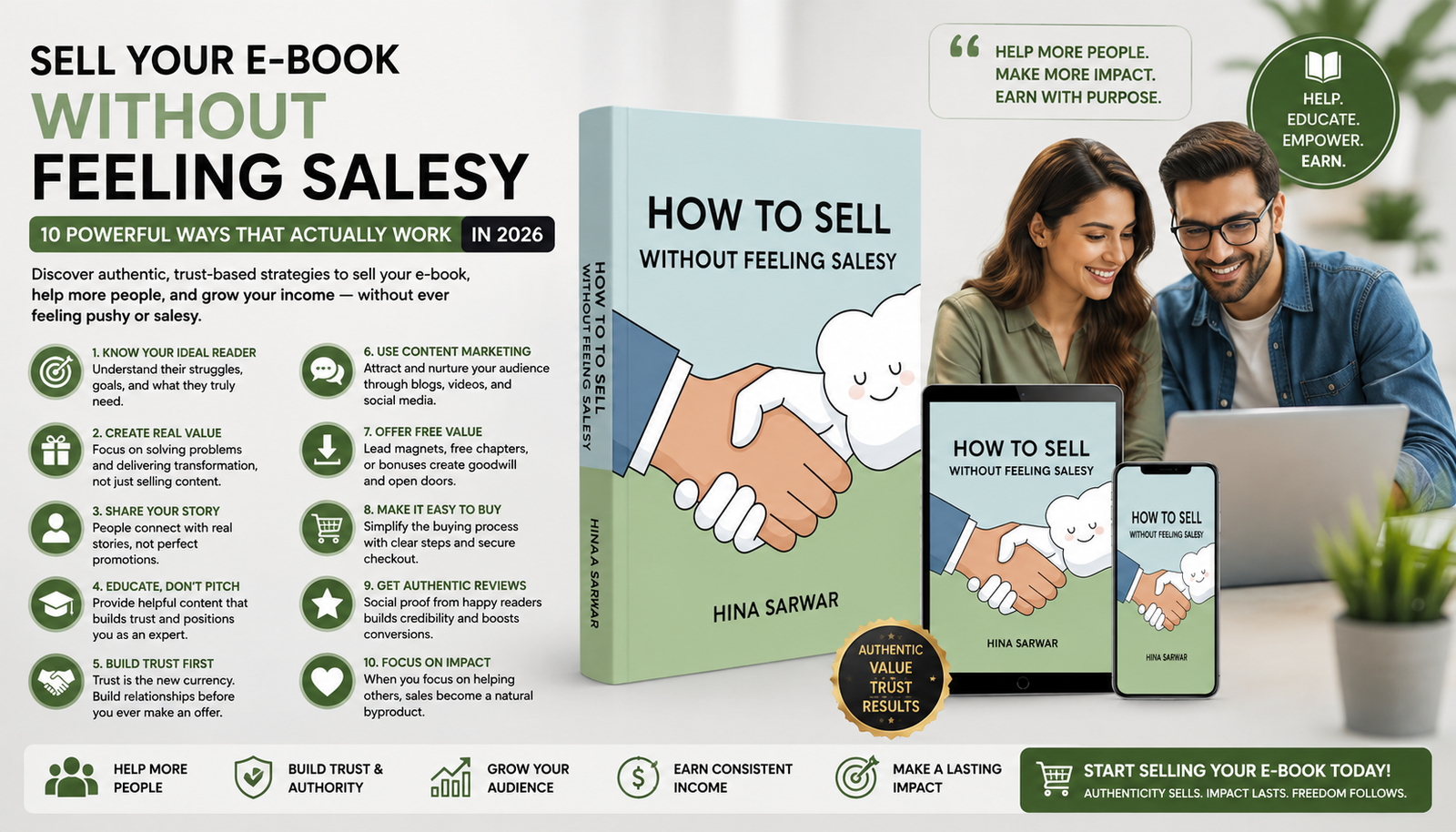
Introduction:
Selling your e-book can feel uncomfortable, awkward, and even embarrassing for many creators. You have poured your heart, soul, and countless hours into writing something valuable, yet when it comes time to ask people to buy it, your confidence suddenly disappears. This is an incredibly common experience shared by writers, teachers, professionals, and creators across India and around the world. The fear of being perceived as pushy, desperate, or overly commercial often prevents talented individuals from sharing their work with those who could genuinely benefit from it. However, here is the fundamental truth that changes everything: you can absolutely sell e-book without feeling salesy when you adopt the right mindset and implement proven strategies that focus on helping rather than pushing. The digital content economy in India is experiencing remarkable growth, with the e-book market expanding at more than 9 percent annually between 2026 and 2031, creating unprecedented opportunities for creators who understand how to position their work authentically. This comprehensive guide presents ten powerful strategies that will transform your approach to selling, allowing you to confidently sell e-book without feeling salesy while building genuine connections with your readers. Each strategy is carefully designed to be practical, actionable, and rooted in the psychology of trust and genuine human connection. Whether you are a first-time author, a teacher sharing educational resources, a professional offering expertise, or a student with a story to tell, these approaches will help you share your work with the world while maintaining your integrity and comfort. The key lies in shifting your perspective from seeing selling as a transaction to viewing it as an opportunity to serve, educate, and connect with people who genuinely need what you have created. Let us explore each of these transformative strategies in detail.
Point 1: Share Valuable Educational Content Completely Free Before You Ever Ask Anyone to Purchase Your E-book

The most powerful and authentic way to sell e-book without feeling salesy is to establish yourself as a generous and knowledgeable resource by sharing high-quality educational content absolutely free before you ever mention your e-book. This approach fundamentally changes the dynamic between you and your potential readers because it positions you as a helpful guide rather than a pushy seller. When you consistently provide valuable tips, practical advice, interesting insights, and useful information related to your topic without asking for anything in return, you naturally build trust, credibility, and goodwill with your audience. People begin to recognize you as someone who genuinely cares about helping others rather than someone who only wants to make a quick sale. This trust is the foundation upon which all successful selling is built, and it allows you to sell e-book without feeling salesy because your audience already knows, likes, and respects you. For instance, if you have written an e-book about healthy cooking and nutrition, you could share free recipes, cooking tips, and nutritional advice on your blog or social media platforms. If your e-book focuses on exam preparation and study techniques, you could create free videos, write detailed blog posts, or host live sessions sharing your best strategies. If your e-book is about starting a small business, you could offer free templates, checklists, and step-by-step guides for the early stages of entrepreneurship. The key is to provide so much value that people naturally become curious about what else you have to offer. They start thinking to themselves, “If this free content is so helpful and insightful, imagine how valuable the full e-book must be.” This curiosity leads them to seek out your e-book on their own, without you ever having to push or pressure them. This approach to sell e-book without feeling salesy works because it is built on generosity rather than greed, service rather than salesmanship, and genuine human connection rather than transactional manipulation. When people feel that you have already given them something valuable, they are much more willing to invest in your paid content because they trust that you will deliver even more value. This is the fundamental shift that transforms selling from something uncomfortable into something natural and rewarding.
Point 2: Strategically Share Small Snippets, Quotes, and Key Insights from Your E-book to Create Curiosity

Another highly effective and non-pushy strategy to sell e-book without feeling salesy is to strategically share small excerpts, powerful quotes, and key insights from your e-book across various platforms where your target audience spends their time. This approach works brilliantly because it gives people a genuine taste of your writing style, your unique perspective, and the value contained within your full e-book without requiring them to make any commitment or investment upfront. When you share a compelling quote, an interesting statistic, a thought-provoking idea, or a short story from your e-book, you are essentially offering a preview that stimulates curiosity and creates a desire to explore further. This method of sharing pieces of your work allows you to sell e-book without feeling salesy because you are not asking anyone to buy anything; you are simply sharing interesting content that happens to come from your e-book. People who find your snippets valuable and engaging will naturally want to access the complete collection of insights and ideas that you have compiled. You can share these snippets on various social media platforms including Instagram, LinkedIn, Twitter, and Facebook, where they can reach a wide audience and generate organic interest. You can also include them in your email newsletter, on your personal blog, or even in guest posts you write for other publications. The presentation of your snippets matters significantly in how effectively you can sell e-book without feeling salesy. Instead of bluntly stating “buy my book,” you can gently conclude each snippet with a soft invitation such as “this is just one small insight from my complete e-book” or “if you found this thought-provoking, you might enjoy exploring the full collection of ideas in my e-book.” This respectful and non-demanding approach leaves the decision entirely in the hands of your audience while simultaneously giving them a compelling reason to consider purchasing your full e-book. The psychological principle at work here is called the “curiosity gap,” where people naturally want to fill the gap between what they know and what they could know. When you provide just enough information to spark their interest but not enough to satisfy their curiosity completely, they become motivated to seek out the complete source, which in this case is your e-book. This subtle yet powerful approach to sell e-book without feeling salesy respects your audience’s autonomy while effectively generating genuine interest in your work.
Point 3: Share Authentic Stories and Real-Life Examples of People Who Have Benefited from Your E-book
Human beings are naturally drawn to stories, and sharing authentic narratives about real people who have experienced genuine transformation through your e-book is one of the most powerful ways to sell e-book without feeling salesy. Stories create emotional connections that facts and features simply cannot achieve on their own. When you tell a compelling story about someone who faced a challenge, discovered your e-book, implemented your advice, and achieved meaningful results, you are providing powerful social proof while simultaneously making your content relatable and inspiring. This approach allows you to sell e-book without feeling salesy because you are not talking about your e-book in abstract terms; you are showing the real, tangible impact it has had on actual human beings. The Indian context provides countless opportunities for such storytelling, as there are many inspiring examples of creators who have successfully shared their work with the world. Consider the story of Pranav Shashibhushan Bayari, a 15-year-old student from Belagavi who wrote a 460-page suspense thriller novel while balancing his full-time studies and published it independently on Amazon Kindle Direct Publishing, receiving 5-star ratings and earning significant income. Then there is the inspiring case of Ankur Warikoo, who has sold over one million copies of his books and earned approximately 4.5 crore rupees in royalties by transforming his existing blog posts, videos, and conversations into cohesive books that reflect his authentic voice and valuable insights. We also see examples like the Delhi homemaker who began writing on the Pratilipi platform out of casual curiosity and went on to create the Murdon ki Train trilogy, which has been read more than 17 million times, enabling her to earn up to 4 lakh rupees per month. These stories demonstrate that anyone with determination and valuable knowledge can successfully sell e-book without feeling salesy when they approach their work with authenticity and a genuine desire to help others. When you share such transformation stories, you are essentially saying, “This e-book helped someone overcome a challenge or achieve a goal, and it might help you too.” This is far more compelling and far less salesy than simply stating, “This e-book is great, buy it now.” The emotional resonance of stories creates trust and motivates action in a way that simple advertising never can. This storytelling approach to sell e-book without feeling salesy is deeply human, naturally engaging, and remarkably effective at converting curious readers into satisfied customers.
Point 4: Offer a Complete Sample Chapter of Your E-book for Free Download

One of the most generous and confidence-building strategies to sell e-book without feeling salesy is to offer the complete first chapter of your e-book absolutely free for download, allowing potential readers to experience your work directly before making any purchasing decision. This approach eliminates the risk and uncertainty that often prevents people from buying e-books because they worry about wasting money on content that might not meet their expectations. When you confidently offer a free sample chapter, you are essentially saying to your potential readers, “I am so confident that my e-book will provide value to you that I want you to test it out before you commit to buying.” This builds tremendous trust and credibility, which are essential when you want to sell e-book without feeling salesy. The psychology behind this strategy is straightforward and powerful. When someone downloads and reads your free chapter, they invest time and attention in your content. If they find it valuable, engaging, and relevant to their needs, they are highly likely to want to continue reading the rest of the e-book. They have already experienced your writing style, your expertise, and the value you provide, so the decision to purchase becomes an easy and natural next step rather than a risky gamble. You can offer your free sample chapter through your website, your email list, social media platforms, or even through dedicated landing pages designed specifically for this purpose. The way you present your free chapter matters significantly in how effectively you sell e-book without feeling salesy. Instead of simply providing the download link, you can create an engaging page that briefly explains what the e-book covers, why you wrote it, and who it is for, with a clear and inviting button that says something like “Download Your Free Chapter” or “Read the First Chapter Free.” This approach respects your potential readers’ autonomy while providing them with a genuine opportunity to evaluate your work. Offering a free chapter demonstrates your confidence in your content and your commitment to providing value, both of which are essential characteristics of someone who can authentically sell e-book without feeling salesy. This strategy is particularly effective because it allows people to self-qualify; those who enjoy the sample chapter are precisely the people who will find value in the full e-book and will become your most satisfied customers.
Point 5: Build a Dedicated Email List and Send Regular, Friendly, Value-Filled Communications

Email marketing remains one of the most effective and personal ways to sell e-book without feeling salesy, provided you approach it with the right mindset and strategy that prioritizes relationship-building over transactional messaging. Your email list represents people who have already shown interest in what you have to say by voluntarily providing their contact information, making them significantly more likely to become paying customers than random strangers who stumble upon your content. However, the key to success when using email to sell e-book without feeling salesy lies entirely in how you communicate with your subscribers. The most effective approach is to treat your email list like a group of friends or community members with whom you share updates, insights, personal stories, and valuable information, rather than a list of potential customers to bombard with sales messages. Your emails should primarily focus on providing value through helpful tips, interesting observations, personal reflections, behind-the-scenes insights into your writing journey, and thoughtful questions that encourage engagement and replies. Only occasionally, and always naturally and contextually, should you mention your e-book. This philosophy of generosity-first communication enables you to sell e-book without feeling salesy because your subscribers come to see you as a trusted guide and friend rather than a salesperson. They look forward to your emails because they know they will receive something valuable, interesting, or inspiring each time. For example, you might send an email sharing a personal story about a challenge you faced while writing your e-book and how you overcame it, then naturally mention at the end, “By the way, my e-book covers this topic in much more detail if you are interested.” This feels like a friend sharing something helpful rather than a salesperson pushing a product. The cumulative effect of consistently providing value through email is that when you do mention your e-book, your subscribers are receptive and interested because you have already demonstrated your expertise and generosity over time. This relationship-first approach to sell e-book without feeling salesy builds long-term loyalty, repeat customers, and word-of-mouth referrals that far outweigh the results of any aggressive sales campaign. Remember that your email list is your most valuable marketing asset because it represents a direct line to people who have chosen to hear from you, making it the ideal channel for authentic and effective e-book promotion.
Point 6: Appear as a Guest Expert on Relevant Podcasts and Webinars in Your Niche

Being invited as a guest expert on podcasts, webinars, or live online events is an exceptionally effective and non-salesy way to reach new audiences and sell e-book without feeling salesy by positioning yourself as a knowledgeable authority in your field. When you appear as a guest on someone else’s platform, you are introduced by the host as an expert, which immediately grants you credibility and trust without you having to promote yourself. The focus of your appearance should be on providing tremendous value to the audience by sharing your expertise, answering questions, offering practical tips, and telling engaging stories related to your topic. When you deliver genuine value in this setting, the audience naturally becomes curious about who you are and what else you have to offer, making them receptive to learning about your e-book. The most effective way to sell e-book without feeling salesy in this context is to focus entirely on being helpful during your appearance and only briefly mention your e-book near the end, usually in response to a host’s question about your work. For example, the host might ask, “So where can people learn more about your approach?” or “Do you have any resources for people who want to dive deeper into this topic?” This provides a natural, non-pushy opportunity to mention your e-book, your website, or your newsletter. You can also mention your e-book by referencing it as part of your story, such as “I struggled with this problem for years until I finally developed a system that worked, which I eventually turned into my e-book to help others facing the same challenges.” This approach to sell e-book without feeling salesy works because you are not actively selling; you are simply sharing your journey and offering your e-book as a resource for those who want to learn more. The host’s endorsement and the audience’s experience of your expertise combine to create genuine interest that often leads to sales without any pressure whatsoever. Finding podcast and webinar opportunities requires reaching out to hosts and producers with a clear proposal of what value you can provide to their audience. Research shows that podcast appearances can significantly increase e-book sales because listeners feel they already know and trust you before they even visit your website.
Point 7: Use Gentle, Inviting, and Respectful Language in Your Calls-to-Action

The specific words and phrases you choose when inviting people to purchase your e-book make an enormous difference in whether you come across as salesy or authentic, so learning to use soft, respectful, and inviting language is essential to sell e-book without feeling salesy effectively. Aggressive and demanding language such as “BUY NOW,” “DON’T MISS THIS LIMITED OPPORTUNITY,” “LAST CHANCE,” or “ACT FAST” activates resistance in many potential buyers because it feels manipulative and pressuring. People instinctively resist being pushed or rushed into decisions, and such language often backfires by creating negative associations with your brand. To sell e-book without feeling salesy, you should instead use gentle language that respects the reader’s autonomy, intelligence, and decision-making ability while subtly guiding them toward your e-book. Examples of soft and inviting call-to-actions include: “If this topic resonates with you, you might find my complete e-book valuable,” “For deeper insights and detailed guidance, explore my full e-book,” “I have written an entire book on this subject if you would like to dive deeper,” “Here is a free chapter if you want to explore before deciding,” or “If you are curious to learn more, check out my comprehensive guide.” Notice how these phrases invite rather than demand, suggest rather than insist, and empower the reader to make their own choice rather than pressuring them into a decision. This language respects the fact that not everyone who encounters your content is ready to buy, and that is perfectly okay. By using such gentle language, you position yourself as a generous resource provider who is simply making an offer, not as a desperate salesperson trying to close a deal. This respectful approach to sell e-book without feeling salesy actually increases conversion rates because people feel more comfortable purchasing from someone who respects their autonomy and does not pressure them. The psychological principle at work is that when people feel in control of their decisions, they are more likely to make a positive decision. When you remove the pressure and respect their choice, you create an environment where buying feels like a natural, comfortable extension of the relationship rather than a forced transaction. This subtle but significant shift in language can transform your entire approach to selling.
Point 8: Collaborate and Partner with Other Creators and Influencers in Your Niche

Strategic collaboration with other creators, influencers, and experts in your niche is a powerful and mutually beneficial way to expand your reach and sell e-book without feeling salesy because recommendations from trusted sources carry far more weight than self-promotion. When another creator whom your potential readers already know, like, and trust recommends your e-book, that recommendation comes across as genuine and helpful rather than salesy. The fundamental principle behind this strategy is that people trust recommendations from people they already respect, so partnering with such individuals allows you to reach new audiences through the filter of their established trust. There are many ways to collaborate with other creators to sell e-book without feeling salesy, including writing guest posts for each other’s blogs, appearing as guests on each other’s podcasts or YouTube channels, hosting joint webinars or live sessions together, bundling your e-books with complementary works from other creators, cross-promoting each other’s content on social media, or even co-creating new content that draws on both of your areas of expertise. The key is to find creators whose audience aligns with yours but whose content is complementary rather than directly competitive. For example, if you have written an e-book about yoga and wellness, you could partner with a fitness influencer, a meditation teacher, or a nutrition expert to reach their audiences with relevant and complementary value. When you collaborate effectively, you sell e-book without feeling salesy because the recommendation comes from a trusted source, not from you directly. The collaborator’s audience sees the partnership as an opportunity to discover something valuable that they might otherwise have missed. Additionally, collaborations often create synergy where the combined effort is greater than the sum of individual efforts, leading to increased visibility, credibility, and sales for all parties involved. The Indian creator ecosystem is rich with opportunities for collaboration, from established authors and educators to rising influencers and subject matter experts across various fields and regional languages. By actively seeking out and nurturing these mutually beneficial partnerships, you can dramatically expand your reach while maintaining an authentic and non-salesy approach to selling your e-book.
Point 9: Exercise Patience and Maintain Consistent Effort Over Time

Perhaps the most overlooked yet essential element of successfully selling your e-book without feeling salesy is the practice of patience combined with consistent, sustained effort over an extended period. Many creators make the mistake of expecting immediate results, trying a few promotional strategies for a week or two, and then giving up when they do not see instant sales. However, the reality of authentic and non-salesy selling is that it takes time to build the trust, visibility, and relationships that ultimately lead to sales. You need to consistently show up, share valuable content, engage with your audience, and nurture connections over months and even years to effectively sell e-book without feeling salesy. The psychological principle underlying this is that people typically need to encounter you and your content multiple times before they feel comfortable enough to make a purchase. This is often referred to as the “rule of seven” in marketing, suggesting that people need to see your message approximately seven times before they take action. This means your consistent presence and value delivery over time are what eventually create the conditions for natural, comfortable sales. When you are patient and consistent, you sell e-book without feeling salesy because your audience has had sufficient time to know you, like you, and trust you before you ever ask them to buy. They have seen your free content, read your email newsletters, engaged with your social media posts, and perhaps even interacted with you directly through comments or messages. By the time you mention your e-book, it does not feel like a sales pitch because you have already given them so much value. It feels like a natural next step in an ongoing relationship. This patience is particularly important in the Indian context, where trust is often built through long-term relationships and personal connections. The most successful Indian creators and authors did not become overnight sensations; they consistently shared their work, engaged with their audience, and gradually built their following over years. Remember that every interaction you have with your audience is an investment in future sales, and the cumulative effect of consistent effort over time is what ultimately enables you to sell e-book without feeling salesy while building a sustainable and rewarding career as a creator.
Point 10: Carefully Select the Right Platform That Aligns with Your Goals and Values

The platform you choose to sell your e-book significantly affects your experience of the selling process and your ability to sell e-book without feeling salesy, so careful platform selection based on your specific goals, values, and audience needs is essential. Different platforms offer different advantages, control levels, and relationships with customers, and the right choice can make the difference between a comfortable selling experience and a frustrating one. Amazon Kindle Direct Publishing (KDP) is the most popular platform, offering massive reach and discoverability with millions of active book buyers, but it takes 30 to 65 percent of every sale and you do not receive your customers’ email addresses, limiting your ability to build direct relationships. While Amazon can help you reach a wide audience, the lack of direct customer data can make it harder to sell e-book without feeling salesy because you cannot nurture relationships beyond the initial sale. Creator marketplaces like Gumroad, Payhip, and Lemon Squeezy take a smaller percentage of your sales, provide you with customer email addresses for relationship-building, and offer more control over pricing and branding, allowing you to create a more personal selling experience. In India, platforms like Pratilipi, Pothi.com, and Flipkart eBooks are gaining popularity, with Pratilipi supporting twelve Indian languages and hosting over 720,000 writers, creating unique opportunities for regional language content. The smartest approach to sell e-book without feeling salesy often involves using multiple platforms strategically: Amazon for initial discovery and reach, a creator marketplace for direct sales and customer relationships, and regional platforms for access to specific Indian language audiences. When you use a platform that allows you to collect customer email addresses, you can continue to build relationships through newsletters and future product launches, making it easier to sell e-book without feeling salesy in the long term. The platform you choose should align with your values, your audience’s preferences, and your long-term goals as a creator. Consider what matters most to you: maximum reach, customer relationship building, control over pricing and branding, or support for regional languages. Making an informed platform choice empowers you to sell with confidence and authenticity.
Conclusion: Embrace Authentic Selling as a Form of Generous Service

We have now explored ten comprehensive strategies that will help you sell e-book without feeling salesy, and the common thread running through all of them is the understanding that authentic selling is not about taking, manipulating, or pressuring, but rather about generously serving, educating, and connecting with people who can genuinely benefit from what you have created. When you share valuable content for free, you build trust and credibility that naturally leads to sales. When you share snippets and stories, you create curiosity and emotional connection that motivates action. When you offer free samples, you demonstrate confidence and reduce risk for buyers. When you build email relationships, you create lasting connections that transcend any single transaction. When you collaborate with others, you expand your reach through trusted recommendations. When you use gentle language, you respect autonomy and build comfortable buying environments. When you exercise patience and consistency, you create the time needed for trust to develop naturally. And when you choose the right platform, you empower yourself with the tools and data needed for authentic relationship-building. The Indian e-book market is experiencing extraordinary growth, with projections indicating continued expansion through 2026 and beyond, creating unprecedented opportunities for creators who understand how to sell e-book without feeling salesy through these authentic and relationship-centered approaches. Whether you are a student like Pranav who dreamed of writing a novel, a teacher with educational resources to share, a professional with expertise to offer, or someone with a story waiting to be told, these strategies provide a clear and comfortable path to sharing your work with the world. Remember that every time you help someone solve a problem, learn something new, or find inspiration through your e-book, you are providing genuine value that is worth sharing. Embrace selling not as a necessary evil but as a meaningful way to connect with those who need what you have to offer. Your knowledge, insights, and stories have the power to transform lives, and sharing them through your e-book is an act of service that benefits both you and your readers.
Security was my main concern when I signed up but they put all my worries to rest immediately. Two factor authentication and secure payment gateways make me feel completely protected. The support agents are patient and actually explain everything clearly. A refreshing platform that puts player satisfaction first every single time. bd47777bdt
It’s so true that selling can feel uncomfortable, especially when it’s something you’ve invested so much in. I really appreciated the tips on building authentic connections. It’s refreshing to see strategies that focus on engagement rather than just pushing a product. Helping readers see the value in your work without the hard sell is definitely a game changer! besttranslationearbuds.com
I really resonate with the idea that selling an e-book doesn’t have to feel salesy. It’s encouraging to see practical strategies being highlighted, especially the emphasis on building genuine connections with your audience. It’s a refreshing reminder that authenticity can make a huge difference in our approach to promoting our work. setlistcards.com
I appreciate how you highlighted the discomfort many creators face when selling their e-books. Your suggestion to focus on building genuine relationships with potential readers instead of just pushing a sale is so refreshing. It really shifts the perspective and makes the process feel more authentic and less intimidating. meltcheck.com
I love how you addressed the internal struggle so many writers experience when it comes to selling their work. Your emphasis on sharing personal stories to connect with readers was particularly eye-opening. It makes the whole selling process feel not just like a transaction, but a meaningful exchange between creator and audience. yesornoai.com/wheel
Your point about embracing storytelling to connect with readers really resonated with me. Instead of just selling an e-book, sharing the journey and the inspiration behind it can create a much deeper connection. It’s a powerful reminder that people are often drawn to the story behind the product. chartstitch.com
I love how you emphasized the importance of storytelling in connecting with potential readers. This approach not only makes the selling process feel less intimidating but also creates a genuine bond with the audience. It’s a great way to showcase the value of the e-book while staying true to the creator’s passion. dreamlux.ai
I particularly resonated with your point about showcasing personal stories to connect with readers. It can feel so much less daunting to share my journey alongside my e-book. Making that emotional connection really does change how I approach selling, turning it into a conversation rather than a sale. roommakeover.io
I love the point you made about sharing personal stories as a way to connect with potential readers. It really emphasizes that marketing doesn’t have to be cold or sales-driven; instead, it can be an opportunity to engage in meaningful conversations. That approach not only builds trust but also fosters a community around your work. kcalmath.com
I found it fascinating how you emphasized the importance of storytelling when selling e-books. Connecting with readers through personal anecdotes can create a powerful bond and make the offer more enticing. It’s a brilliant way to engage with potential buyers and make them feel invested in the journey! thespecref.com
Your insight about leveraging social media to build a community around your e-book was spot on. It really highlights how important it is to create an environment where readers feel engaged rather than pressured to buy. Fostering that sense of community can truly transform the sales experience into a shared journey with your audience, making it far less intimidating. coloringloft.com
I found your insight on leveraging social media as a platform to connect with readers particularly insightful. It’s refreshing to consider that engaging authentically with my audience can actually make the selling process feel more like a conversation. This perspective has definitely shifted how I plan to promote my e-book, turning what often feels like pressure into a creative opportunity! playhopearth.com
Your emphasis on the importance of understanding the audience’s needs before launching into a sales pitch really struck a chord with me. It’s a refreshing approach that shifts the focus from selling to really serving. By tailoring my message to what readers are looking for, I feel much more confident about sharing my e-book without feeling pushy. It’s all about creating value, and your insights are incredibly helpful for that! pdftranslate.io
Your insight about focusing on the value your e-book brings to readers truly struck a chord with me. Reminding creators to emphasize how their work solves problems or enriches lives can transform the way we approach selling. It not only eases the pressure of “selling” but also positions us as valuable resources for our audience. That perspective shift is so empowering! emojimaker.cc
Your insights on the importance of understanding your audience’s needs before promoting an e-book hit home for me. It’s so true that when we tailor our approach to genuinely address what readers are seeking, it not only eases the pressure of selling but also fosters a deeper connection. This method transforms the process into something much more rewarding and less sales-focused. youtubegpt.ai
Your point about the importance of understanding your audience really struck a chord with me. When we tailor our message to their specific needs and interests, it transforms the selling process from feeling like a hard sell to a meaningful exchange. It’s a real game-changer in how we engage potential readers and promote our work authentically. stubmath.com
I found your suggestion to leverage social media for engagement particularly insightful. It’s true that positioning ourselves as approachable and relatable can transform how we connect with potential readers. By sharing snippets from the e-book and interacting directly, the sales process becomes more about conversation than just a transaction, making it feel much more genuine. runfrom67.com
Your insights on the fear of selling e-books truly hit home for me. I appreciate how you suggested using social media not just as a platform for promotion but as a space to engage and connect with potential readers. This approach really encourages creators to share their authentic selves and foster community, making the selling process feel much more natural and enjoyable. It’s such a game changer to think about sales as building interest rather than just pushing a product. tradebalancer.com
Hey guys! 3450kbet is a new one I’ve been playing around with. Not bad, got some cool bonuses. The odds are fairly competitive. Give it a whirl: 3450kbet