

Description (freelance e-books 2026)
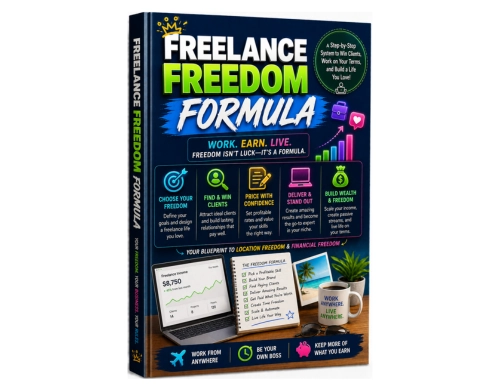
The world of freelance e-books 2026 is full of opportunity, but it is also full of noise. Every day, new writers publish books hoping to earn money online, and most of them quit within three months because they never learned the simple rules of the game. This blog post was written to change that. In the ten points above, we covered the entire journey—from choosing a low-competition, high-demand niche to pricing your book for the Indian reader’s pocket, from using AI as a helpful assistant to building an email list that becomes your real gold. You learned why freelance e-books 2026 rewards specificity over big ideas, why Amazon KDP and Gumroad work best together, and why short videos on your phone can sell more books than a perfect cover ever will. We shared real Indian success stories—like Ankur Warikoo, who earned roughly ₹4.5 crore in royalties, and Seemran Sahoo, who used an old phone and AI to earn $3 million—to prove that this path is not a fantasy. It is a system. You also saw the six mistakes that kill most new authors and the simple 14-day plan to write and publish your first short book. Every section was designed to be practical, honest, and easy to understand, whether you are a school student in Jaipur or a working professional in Bengaluru. The core message is simple: freelance e-books 2026 is not about being a born writer. It is about solving one clear problem for one specific reader and showing up consistently. You do not need a big investment or a perfect plan. You need one small step, taken today. This description is your map. The next move is yours.
1. Start With One Real Problem, Not a Big Topic (freelance e-books 2026)

The first and biggest mistake new writers make in freelance e-books 2026 is trying to write about a huge topic like “money” or “health.” Big topics are crowded and hard to rank for. The winning way is to solve one clear problem for one specific person. Ask yourself: who is my reader, and what keeps them awake at night? If you write for “everyone,” you will sell to no one. Instead, write for a school teacher in a small town who wants a side income, or a freelancer in Bengaluru who struggles with irregular payments. That is how freelance e-books 2026 actually work. A book like “5 AI Tools for Indian Teachers to Earn ₹15,000 a Month” will sell better than a generic “AI for Beginners” book, because the reader feels you are talking directly to them. The data backs this up: a niche with 10,000 desperate buyers outperforms a topic with 1 million casual browsers. Specificity is not a small detail—it is the whole game. This simple shift—from broad to narrow—is the foundation of success in freelance e-books 2026. Before you write a single word, write one sentence: “This book helps ______ to ______.” If you cannot fill in both blanks clearly, stop and rethink. The authors who win in freelance e-books 2026 are not the ones with the biggest ideas. They are the ones with the clearest problems to solve.
2. Choose a Low-Competition, High-Demand Niche That People Actually Pay For (freelance e-books 2026)

Not all niches are equal. Some are crowded with free content, and some have thousands of buyers searching every month with very few good books. For freelance e-books 2026, the smart way is to look for micro-niches—very specific topics that are underserved. The best opportunities right now include AI productivity workflows for specific professions, personal finance for freelancers and Gen Z, health micro-niches like gut health and sleep optimisation, and career transition playbooks. Trending topics show real buyer momentum when year-over-year search growth is above 40%, existing bestsellers are older than 18 months or thin, and active communities are asking questions that current books do not answer. The golden rule is: a small group of desperate buyers beats a huge group of casual browsers. How do you check competition? Look at review counts. If the top five books each have thousands of reviews, the niche is locked. If top sellers sit around 50–300 reviews, there is proven demand with room for a new, well-targeted entrant. This research step is what separates hobby writers from serious creators in freelance e-books 2026. Take your time here. One hour of niche research can save you three months of writing a book nobody wants. Use free tools like Amazon’s auto-suggest to confirm that people are actually searching for your narrower phrase. Do not guess—verify. That is the professional way to approach freelance e-books 2026.
3. Use AI for Speed, But Never Let It Replace Your Voice (freelance e-books 2026)

AI tools like ChatGPT and Claude are powerful, and in freelance e-books 2026 they are normal parts of the workflow. You can create an outline and a first draft in hours instead of weeks. But here is the human truth: readers can smell pure AI writing from a mile away. It feels flat, generic, and has no soul. The winning formula is AI writes the skeleton, you add the heart. Use AI to generate chapter structures and rough paragraphs, then rewrite them with your own stories, Indian examples, and simple explanations. Add local context—UPI payments, Indian exam systems, small-town struggles—that AI will never know. This is how freelance e-books 2026 succeed: speed from machines, trust from humans. If you let AI do 100% of the work, your book will hit a low ceiling and never build a loyal audience. The authors who treat AI as a research assistant and first-draft generator—not as a replacement for their own thinking—are the ones who build real catalogues that sell month after month. Your voice is your only real advantage. In a market flooded with AI-generated content, being unmistakably human is a competitive edge, not a weakness. The readers of freelance e-books 2026 do not want perfect prose. They want someone who understands their problem and explains the solution in plain, honest language.
4. Price for the Indian Reader’s Pocket, Not for Your Ego (freelance e-books 2026)

Many new authors price their e-book too high because they think a higher price means more value. In freelance e-books 2026, the opposite is often true for Indian readers. A student or young professional will happily pay ₹99 to ₹299 for a short, focused guide that solves a real problem, but they will hesitate at ₹999. On Amazon KDP India, the 70% royalty option is available for books priced between ₹99 and ₹599, which means pricing smartly can actually double your per-copy earnings. The best strategy is to start low, deliver high value, and raise the price only when you have reviews and proof. A ₹199 book that sells 100 copies builds more trust and income than a ₹999 book that sells 10. The math is simple: volume at a fair price beats a high price with no buyers, especially in the early days when you are still building your reputation. Remember, in freelance e-books 2026, your first goal is not profit—it is getting readers to trust you. Price is a signal, not just a number. Indian self-publishers who understand this often generate better total revenue through lower pricing and higher volume than through premium pricing. Do not price for your ego. Price for the reader’s reality. That is the mature approach to freelance e-books 2026.
5. Publish Where Indians Actually Buy — Amazon KDP and Gumroad Together (freelance e-books 2026)

You do not need a big publisher or a fancy website to sell in freelance e-books 2026. Two platforms are enough to start: Amazon KDP for reach and Gumroad for direct sales. Amazon KDP puts your book in front of the world’s biggest reading audience and pays 35% to 70% royalties, but it owns the customer relationship and does not give you the buyer’s email. Gumroad lets you keep 87% to 95% per sale and gives you the customer email, which is your most valuable business asset. The smart move is to use Amazon for discovery and Gumroad for ownership. Most successful indie authors in 2026 run both channels: Gumroad as the high-margin direct channel for their existing audience, Amazon KDP as the discovery channel for new readers. Pick Gumroad first if you have an email list of any size. Pick Amazon KDP first if you have zero audience and need search to find your book. Together, these two platforms are the backbone of freelance e-books 2026 for Indian creators. Do not wait for perfect conditions. Publish on both, even if your first cover is simple. Every day you delay is a day someone else publishes the book you were planning to write.
6. Build an Email List from Day One — It Is Your Real Gold (freelance e-books 2026)

Social media followers disappear when the algorithm changes, but email subscribers stay with you. In freelance e-books 2026, the authors who earn consistently are not the ones with the most Instagram likes—they are the ones with a direct line to their readers. Start collecting emails before your book is finished. Offer a free chapter, a checklist, or a short guide as a bonus. Use free tools like MailerLite or ConvertKit (free up to 1,000 subscribers) to build your list. Every time someone downloads your free resource, they enter your world. When your book launches, you are not shouting into an empty void—you are telling people who already trust you. This one habit separates the struggling writers from the successful ones in freelance e-books 2026. Your email list is not a “nice to have.” It is the engine of your business. The authors who own the customer email outperform those who rely only on platform algorithms by a wide margin. Amazon can change its rules overnight. Gumroad can change its fees. But your email list belongs to you, and no algorithm can take it away. That is why every serious creator in freelance e-books 2026 treats the email list as the single most important asset to build from the very first day.
7. Use Short Videos to Sell Your Book — Do Not Hide Behind the Cover (freelance e-books 2026)

Publishing a book and hoping people find it is like opening a shop in a jungle. In freelance e-books 2026, you must actively show up where readers scroll. The easiest way is short videos on Instagram Reels, YouTube Shorts, or LinkedIn. You do not need to dance or use fancy editing. Just speak simply into your phone: “I wrote a short book about X. Here is one tip from it. Link in bio.” Post three short videos per week. Each video should solve one tiny problem from your book. This builds curiosity and trust. Authors who use short videos sell significantly more copies than authors who only post text, because video lets people hear your voice and see your face—the human touch that makes freelance e-books 2026 work. The goal is not to go viral. The goal is to be consistently visible to the right people. A video with 500 views from the right audience is worth more than a video with 50,000 views from random scrollers. Do not wait for a professional camera. Your phone is enough. Consistency beats perfection. The creators who succeed in freelance e-books 2026 are the ones who show up every week, even when the views are low, because they understand that trust is built one small video at a time.
8. Learn from Real Indian Success Stories — The Proof Is Everywhere (freelance e-books 2026)

The biggest lie about freelance e-books 2026 is that you need to be a “born writer.” Look at Ankur Warikoo: he sold over one million books and earned roughly ₹4.5 crore in royalties, yet he openly says he did not “write” them in the traditional way. He started blogging in 2005, built an audience on LinkedIn and Quora from 2012, and later worked with editors who sifted through his existing content—600+ videos and 250+ hours of material—to create manuscripts that captured his voice. Then look at Seemran Sahoo, an Indian girl who used an AI writing platform and an old phone to publish fiction and earn $3 million in royalties. And consider the broader reality: Indian self-publishers earning between ₹5,000 and ₹50,000 per month are common, while successful authors cross ₹1 lakh per month. These are not magical stories—they are systematic stories. They started small, solved a specific problem, and stayed consistent. Their examples prove that freelance e-books 2026 is not about luck. It is about using what you already have and starting before you feel ready. You do not need a blank page. You need to curate and structure what you already know.
9. Avoid the Six Mistakes That Kill Most New Authors (freelance e-books 2026)

Most people who try freelance e-books 2026 quit within three months, and the reasons are predictable. Mistake one: writing for everyone instead of someone specific. Mistake two: quitting when the first 90 days bring only ₹0–₹5,000. Mistake three: relying 100% on AI and wondering why sales are flat. Mistake four: ignoring the email list and depending only on social media. Mistake five: using a cover that looks unreadable on a small phone screen. Mistake six: publishing 50 random books across unrelated topics instead of 5–10 focused books in one niche. Avoiding these six mistakes will put you ahead of 80% of beginners in freelance e-books 2026. You do not need to be perfect. You just need to avoid the obvious traps. Slow, focused effort beats fast, scattered effort every single time. The authors who succeed are not the ones who never make mistakes. They are the ones who make small mistakes, learn quickly, and keep publishing. Every book teaches you something the previous one could not. That is how you grow in freelance e-books 2026—not through one perfect launch, but through a series of honest attempts.
10. Take One Small Step Today — Do Not Wait for the “Right Time” (freelance e-books 2026)

The best time to start freelance e-books 2026 was yesterday. The second-best time is today. You do not need a degree, a big investment, or a perfect plan. You need one small action. Here is your simple starting path: Today, write down one problem you can solve for one type of reader. This week, create a five-chapter outline with AI and edit it yourself. This month, write 3,000 words a day for seven days and finish a short draft. Then publish it on Amazon KDP and Gumroad and tell ten people. That is it. That is the entire beginning. The authors who succeed in freelance e-books 2026 are not smarter than you. They simply started before they felt ready and kept going when it felt slow. Your first book will not be perfect. It does not need to be. It just needs to exist. And once it exists, you are no longer someone who talks about writing. You are a published author. That identity shift is the real reward—and it is available to you starting today.
Conclusion (freelance e-books 2026)

The journey of freelance e-books 2026 does not end with publishing a book. It begins there. What you have learned in this post is not just information—it is a set of habits that separate the writers who earn steadily from the ones who fade away. Let us recap the most important takeaways. First, start small. Write for one specific person with one specific problem. Do not try to write for everyone, because a book for everyone is a book for no one. Second, choose a micro-niche with real demand and low competition. Use review counts and search growth to check before you write a single word. Third, use AI for speed but never let it replace your human voice. Your local examples, your stories, and your simple explanations are your real advantage. Fourth, price fairly for the Indian reader, and remember that a ₹199 book selling 100 copies builds more trust than a ₹999 book selling 10. Fifth, publish on Amazon KDP for discovery and Gumroad for ownership. Sixth, build your email list from day one because it is the only asset no algorithm can take away. Seventh, use short videos on your phone to stay visible and build trust. Eighth, learn from real Indian success stories—they are proof that freelance e-books 2026 works when you follow a system. Ninth, avoid the six common mistakes that make most beginners quit. And tenth, take one small action today. Write your one-sentence book idea. Create a five-chapter outline. Write 3,000 words a day for seven days. Publish it and tell ten people. The authors who win in freelance e-books 2026 are not smarter than you. They simply started before they felt ready and kept going when it felt slow. Your first book will not be perfect. It does not need to be. It just needs to exist. And once it exists, you are no longer someone who talks about writing. You are a published author. That identity is the real reward, and it is available to you starting today.
FAQ – 10 Simple Questions and Answers About Freelance E-books 2026
1. What is the main focus keyword for this post?

The main focus keyword is freelance e-books 2026. It appears naturally in the title, subheadings, and body text to help the post rank on Google for people searching about this topic.
2. How much money can a beginner realistically earn from freelance e-books 2026?

Most beginners earn between ₹0 and ₹5,000 in the first three months. If you keep publishing and build an email list, you can reach ₹10,000–₹50,000 per month within a year. The key is patience and consistency, not quick money.
3. Do I need to be a good writer to succeed in freelance e-books 2026?

No. You need to be a clear problem-solver. Simple English and honest explanations work better than fancy words. Use AI for the first draft, then rewrite it in your own voice with Indian examples.
4. Which platform is better for Indian creators—Amazon KDP or Gumroad?

Both work best together. Use Amazon KDP for reach and discovery. Use Gumroad for direct sales, higher margins (87–95%), and collecting customer emails. Start with whichever matches your current audience size.
5. How do I find a low-competition, high-demand niche for freelance e-books 2026?

Look for micro-niches—very specific topics. Check if the top books have fewer than 300 reviews and if search interest is growing. Examples include AI tools for one profession, exam prep for Indian students, or finance for freelancers.
6. Can I publish an e-book in India and receive payments in rupees?

Yes. Amazon KDP pays to Indian bank accounts in INR, though there is a 10% Singapore tax withholding on Amazon.in sales. Gumroad supports UPI for Indian buyers and pays in INR after a $100 minimum balance.
7. How long should my first e-book be?

A short, focused guide of 20,000 words (about 70 pages) is enough. Do not write a 300-page book for your first attempt. Solve one problem clearly and publish it quickly so you can learn from real readers.
8. What is the biggest mistake new authors make in freelance e-books 2026?

Writing for everyone instead of someone specific. A book for everyone sells to no one. Also, many authors quit at month three when earnings are low. The real growth comes after month ten if you keep publishing.
9. Do I need a professional cover designer?

No. Use Canva’s free templates and make sure your title is readable at thumbnail size (200 pixels wide). A simple, clear cover is better than a fancy one that looks blurry on a phone screen.
10. What is the first step I should take today?

Write one sentence: “This book helps ______ to ______.” Fill in both blanks clearly. Then create a five-chapter outline using AI and edit it yourself. That single action turns you from someone who talks about writing into someone who is actually building a freelance e-books 2026 business.