


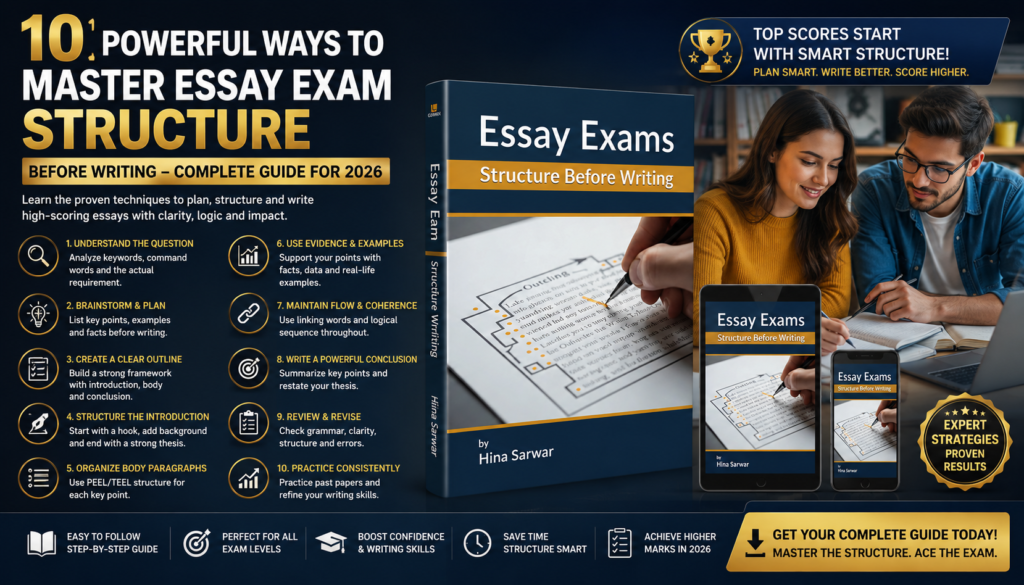
Description:

Do you walk out of exam halls knowing you could have written a better answer? Do you freeze when you see a blank page, unsure where to start? You are not alone. This comprehensive guide reveals why essay exam structure before writing is the single most important skill you can master in 2026. Whether you are a school student preparing for board exams, a UPSC aspirant tackling the Mains Essay Paper, or a professional taking competitive exams like IFSCA Grade A or NABARD Grade A, this guide gives you a complete step-by-step system for essay exam success.
The truth is that essay exam structure before writing is what separates high-scoring students from average ones. Examiners don’t just mark your knowledge – they mark your ability to organise that knowledge, present it logically, and build a convincing argument. A well-structured but moderately knowledgeable answer will almost always score higher than a brilliant but disorganised one. In 2026, with the rise of digital exams and AI-enabled proctoring, this skill has become even more critical.
The National Education Policy (NEP) 2020 has shifted the focus from rote memorisation to critical thinking, analytical skills, and application-based learning. Essay questions are now more sophisticated. They no longer ask you to simply “describe” or “explain” – they ask you to “analyse,” “evaluate,” “compare,” and “synthesise”. This means your essay exam structure before writing must be more thoughtful and strategic than ever before.
This guide covers ten powerful ways to master your essay exam structure before writing. You will learn how to read and analyse questions correctly, brainstorm effectively, create clear outlines, use the PEEL method for body paragraphs, write strong introductions and conclusions, manage your time wisely, and practise regularly to perfect your skills. Each technique is explained in simple, accessible language that school students and professionals alike can understand and apply immediately.
The guide also explores how e-books and digital learning tools can enhance your exam preparation. In 2026, India’s e-book market is growing rapidly, with platforms like Physics Wallah introducing interactive e-books and audio summaries to transform how students revise and interact with study material. Digital exams are becoming the norm, with CBSE introducing online remote invigilation examinations and Bangalore University conducting its first-ever online exams for distance education students. Understanding these trends will help you stay ahead of the curve.
By the end of this guide, you will have a complete toolkit for essay exam success. You will know exactly what to do before you write a single word. You will feel confident, prepared, and ready to tackle any essay question that comes your way. So, whether you are Ramesh the teacher from a small village in Uttar Pradesh, Priya the UPSC aspirant from Chennai, or Ananya the IELTS candidate from Bangalore – this guide is for you. Let’s begin your journey to mastering essay exam structure before writing and achieving the marks you deserve.
Point 1: Understanding Why Essay Exam Structure Before Writing Determines Your Exam Success


Many students walk into exam halls with great knowledge but still score low marks. Why does this happen? The answer is simple. They do not plan their answers before writing. They start writing immediately and hope everything will work out. This is a huge mistake that costs them precious marks. The truth is that essay exam structure before writing is what separates top scorers from average students. When you plan your essay before writing, you create a clear path to follow. You know exactly what points to make, in what order, and how to support each point with evidence. This planning saves time, reduces stress, and helps you write answers that are logical and easy to understand. Think of your essay like building a house. You would never start building without a blueprint. Your essay exam structure before writing is that blueprint. It gives your essay a strong foundation and a clear layout. Examiners are trained to look for structure in answers. They give higher marks to essays that are well-organised and flow smoothly from one point to the next. In 2026, with the new education policies focusing on critical thinking and analytical skills, essay exam structure before writing has become more important than ever. The National Education Policy 2020 has shifted away from rote memorisation towards application-based learning. This means exam questions are more complex and require deeper thinking. You cannot just dump facts on the page anymore. You need to organise your thoughts and present them in a logical way. Digital exams are also becoming more common in India. These exams have strict time limits and you cannot flip back and forth between pages easily. Your essay exam structure before writing must be clear from the start. Students who master this skill find that they feel more confident and less anxious during exams. They know they have a plan to follow. So remember, the first step to scoring well in essay exams is not writing – it is planning. Take five to ten minutes to create your essay exam structure before writing and watch your marks improve dramatically.
Point 2: Read and Analyse the Question Carefully as Part of Your Essay Exam Structure Before Writing

The second essential step in mastering essay exam structure before writing is to read and analyse the question with great care. This step might seem obvious, but countless students skip it and pay the price later. They read the question quickly, think they understand what is being asked, and start writing immediately. Halfway through the exam, they realise they have answered a completely different question. This is one of the most common and costly mistakes students make in essay exams. When you are building your essay exam structure before writing, you must first understand exactly what the examiner wants from you. Every exam question contains specific instructions that tell you what kind of answer is expected. You need to identify three key elements in every question you read. The first element is the instruction words. These are words like explain, analyse, compare, evaluate, discuss, or describe. Each of these words has a specific meaning and tells you exactly what you need to do in your answer. For example, when a question asks you to explain something, you need to describe it in detail and show how it works. When a question asks you to evaluate something, you need to give your judgment and support it with evidence. When a question asks you to compare two things, you need to show both similarities and differences. Understanding these instruction words is a crucial part of your essay exam structure before writing because it determines the type of answer you need to produce. The second element to identify is the topic words. These words tell you what the question is actually about. If the question is about climate change in India, then your answer must focus on climate change in India. You should not write about climate change in other countries or about unrelated topics like pollution or deforestation unless they are directly connected to the question. Staying focused on the topic is an essential part of your essay exam structure before writing because it ensures your answer is relevant and meets the examiner’s expectations. The third element to look for is the focus words. These words give you the specific angle or scope of the question. For example, words like in India, since 2000, or according to the latest data tell you exactly what boundaries your answer must stay within. When you take two to three minutes to read and analyse the question carefully, you are building a solid foundation for your essay exam structure before writing. This small investment of time at the beginning of your exam will save you from writing irrelevant answers and will help you structure your essay more effectively from the very start.
Point 3: Brainstorm All Your Ideas to Strengthen Your Essay Exam Structure Before Writing

The third powerful way to improve your essay exam structure before writing is to brainstorm all your ideas before you start organising them. Brainstorming is a simple but highly effective technique that helps you unlock all the knowledge you have stored in your memory. When you brainstorm, you write down every idea, fact, example, and argument that comes to mind about the topic. You do not worry about order or relevance at this stage. You just get everything out of your head and onto the paper. This is a critical step in developing your essay exam structure before writing because it ensures you do not miss any important points that could strengthen your answer. Many students make the mistake of starting to write immediately after reading the question. They write the introduction, then the first body paragraph, and then they suddenly remember a key point that should have been included earlier. By then, it is too late to add it without disrupting the flow of the essay. Brainstorming prevents this problem completely. When you brainstorm as part of your essay exam structure before writing, you see the full range of points you can make. This helps you choose the strongest arguments and organise them in the most effective order. To brainstorm effectively, take three to five minutes and jot down everything you know about the topic. Use bullet points, short phrases, or even a mind map. Do not judge your ideas at this stage – just write them down. Some of your ideas might seem silly or irrelevant, but they could lead to better points later. The goal is to generate as many ideas as possible. In 2026, many students are using AI tools like ChatGPT and Gemini to help them brainstorm during their preparation. These tools can generate practice questions and explore different perspectives on a topic. However, in the exam hall, you are on your own. So you need to practise brainstorming without any help. The more you practise, the faster and more effective you will become at generating ideas. Remember that brainstorming is an essential part of your essay exam structure before writing. It gives you the raw material you need to build a strong and comprehensive essay. When you have a rich pool of ideas to draw from, you can select the best ones and arrange them in a logical order that will impress the examiner.
Point 4: Create a Clear Outline as the Foundation of Your Essay Exam Structure Before Writing

The fourth way to master essay exam structure before writing is to create a clear and detailed outline for your essay. An outline is like a roadmap that guides you through the entire writing process. It tells you exactly what you are going to write in each section of your essay. Without an outline, your essay will lack direction and coherence. With an outline, your essay will be focused, logical, and easy to follow. Creating an outline is one of the most important steps in developing your essay exam structure before writing because it gives you a clear plan to follow. When you have an outline, you never have to stop and wonder what to write next. You just follow your plan. This saves you precious time during the exam and reduces your stress levels significantly. A good outline for an essay exam typically includes three main parts. The first part is the introduction. Your introduction should state your main argument or thesis clearly. It should also briefly outline the points you will cover in the body of your essay. This gives the examiner a roadmap and shows that you have planned your essay exam structure before writing. The second part is the body. The body of your essay should have several paragraphs, each focusing on one main idea. Your outline should list these main ideas in the order you will present them. For each idea, you should also note what evidence or examples you will use to support it. The third part is the conclusion. Your conclusion should summarise your main argument and reinforce your thesis. It should leave the examiner with a strong final impression. To create your outline, look at the ideas you generated during brainstorming. Group similar ideas together and decide on the main points you want to make. Then arrange these points in a logical order. For example, you might start with the most important point, followed by supporting points, and end with a counter-argument or a concluding thought. Your outline does not need to be long or detailed. Just a few words or phrases for each section is enough. Spend about five to eight minutes creating your outline. This is one of the most valuable investments of time you can make in your essay exam structure before writing. Top students always create an outline before they start writing. They know that a few minutes of planning can save them from writing a disorganised and confusing essay. So make outlining a non-negotiable part of your exam strategy and watch your marks improve.
Point 5: Use the PEEL Method for Each Body Paragraph in Your Essay Exam Structure Before Writing

The fifth powerful way to improve your essay exam structure before writing is to use the PEEL method for each body paragraph in your essay. The PEEL method is a simple but highly effective technique that helps you write clear, focused, and well-supported paragraphs. PEEL stands for Point, Evidence, Explanation, and Link. This method is widely used by successful students and teachers around the world because it provides a clear structure for every paragraph you write. When you incorporate the PEEL method into your essay exam structure before writing, you ensure that each paragraph makes a strong and persuasive contribution to your overall argument. The first element of the PEEL method is Point. You start each body paragraph by stating your point clearly and concisely. This is the main idea of the paragraph and it should directly support your overall thesis. Your point should be a complete sentence that tells the examiner exactly what you are going to argue in this paragraph. The second element is Evidence. After stating your point, you need to provide evidence to support it. This evidence could be a fact, a statistic, an example, a quotation from a source, or any other form of supporting information. Your evidence should be relevant and credible. The third element is Explanation. This is where you explain how your evidence supports your point. Do not just present the evidence and move on. You need to analyse it and show the examiner why it matters. Explain what the evidence means, how it connects to your point, and why it is important for your overall argument. The fourth element is Link. This connects the paragraph back to the essay question or to the next paragraph. A good link shows the examiner that you are building a coherent argument and that each paragraph flows logically into the next. Using the PEEL method is an excellent way to ensure that your body paragraphs are well-structured and persuasive. It is an essential part of your essay exam structure before writing because it gives you a template to follow for each paragraph. You do not have to guess what to write – you just follow the PEEL formula. This saves you time and ensures your paragraphs are coherent and convincing. For example, if you are writing an essay about the impact of technology on education, you might write a paragraph like this. Point: Technology has transformed the way students learn in India. Evidence: According to a 2026 report, over 80% of Indian students now use digital devices for their studies. Explanation: This widespread access to technology has made learning more interactive and accessible, allowing students to explore topics beyond their textbooks. Link: Therefore, technology is not just a tool but a fundamental part of modern education. As you can see, the PEEL method makes your writing more focused and impactful. So when you are planning your essay exam structure before writing, make sure you decide on the PEEL elements for each body paragraph.
Point 6: Write a Strong Introduction That Sets Up Your Essay Exam Structure Before Writing

The sixth way to master essay exam structure before writing is to craft a strong and compelling introduction. Your introduction is the very first thing the examiner reads, and it creates an immediate impression of your writing ability. A weak introduction can confuse the examiner and make your entire essay seem disorganised from the start. A strong introduction, on the other hand, grabs the examiner’s attention, clearly states your argument, and shows that you have carefully planned your essay exam structure before writing. A good introduction should accomplish three important goals. The first goal is to hook the reader. You should start with an interesting fact, a thought-provoking question, a relevant quotation, or a surprising statistic. This makes the examiner want to read more and sets a positive tone for the rest of your essay. For example, if you are writing about climate change, you might start with a shocking statistic about rising temperatures in India. The second goal of a strong introduction is to rephrase the question. Show the examiner that you fully understand what is being asked. Use your own words to restate the question and demonstrate your comprehension. This reassures the examiner that your essay will be relevant and on-topic. The third and most important goal is to state your thesis clearly. Your thesis is the central argument of your entire essay. It should be clear, specific, and debatable. A good thesis tells the examiner exactly what position you are taking and gives a preview of the points you will make to support that position. Your introduction should also outline your structure. Briefly mention the main points you will cover in the body of your essay. This gives the examiner a roadmap and shows that you have planned your essay exam structure before writing. For example, you might say something like this essay will first examine the causes of climate change in India, then explore its effects on agriculture and water resources, and finally discuss potential solutions that could be implemented. This outline helps the examiner follow your argument and shows that you have thought carefully about the organisation of your essay. In 2026, with the increasing use of digital exams and AI tools, examiners are looking for essays that are clear and well-organised. A strong introduction is the first step in demonstrating your ability to structure your thoughts effectively. So when you are planning your essay exam structure before writing, spend some time crafting a compelling introduction. It will set you up for success and help you score higher marks. Remember that your introduction is your first chance to impress the examiner, so make it count.
Point 7: Develop Each Body Paragraph with a Clear Focus in Your Essay Exam Structure Before Writing

The seventh powerful way to improve your essay exam structure before writing is to develop each body paragraph with a clear and specific focus. Each body paragraph in your essay should cover one main idea and one main idea only. This makes your essay much easier to read and understand. When you try to cram multiple ideas into a single paragraph, you confuse the examiner and weaken your overall argument. A well-structured essay exam structure before writing ensures that each paragraph has a single, clear purpose that contributes to your overall thesis. To develop a focused body paragraph, you should start with a topic sentence. This sentence states the main idea of the paragraph clearly and directly. It should be a complete sentence that tells the examiner exactly what you are going to discuss in that paragraph. Your topic sentence should also connect back to your thesis statement, showing how this particular point supports your overall argument. After your topic sentence, you should provide evidence to support your point. This evidence could be a fact, a statistic, an example, a quotation, or any other form of supporting information. Make sure your evidence is relevant and credible. Do not just drop a fact and move on. You need to explain how the evidence supports your point. This explanation is where you show the examiner your analytical skills. Explain what the evidence means, why it matters, and how it connects to your argument. Finally, you should link the paragraph back to your thesis or to the next paragraph. This creates a smooth flow and shows the examiner that you have thought about the overall structure of your essay. When you are planning your essay exam structure before writing, decide on the main idea for each body paragraph. Think about what evidence you will use and how you will explain it. This planning will make the writing process much easier and faster. You will not have to stop and think about what to write next – you will already have a clear plan. Remember that the body of your essay is where you develop your argument and convince the examiner of your position. It should be the longest part of your essay, typically making up about seventy percent of the total word count. So invest time in planning your body paragraphs carefully. A well-structured body is the hallmark of a great essay. By focusing on one idea per paragraph, you demonstrate clarity of thought and mastery of the subject. This is a key aspect of your essay exam structure before writing that will impress any examiner and help you achieve higher marks.
Point 8: Write a Strong Conclusion That Reinforces Your Essay Exam Structure Before Writing

The eighth way to master essay exam structure before writing is to write a strong and memorable conclusion. Your conclusion is your final opportunity to make a positive impression on the examiner. It is the last thing the examiner reads before they assign your marks, so it needs to be powerful and effective. A weak conclusion can undermine an otherwise excellent essay by leaving the examiner with a vague or unsatisfactory impression. A strong conclusion, on the other hand, reinforces your argument and gives the examiner a sense of closure and satisfaction. When you plan your essay exam structure before writing, you should also plan your conclusion carefully. A good conclusion should accomplish three important goals. The first goal is to restate your thesis in new and different words. Do not simply copy your introduction word for word. You should rephrase your main argument to show that you have developed your thinking throughout the essay. This demonstrates to the examiner that you have a deep understanding of the topic. The second goal of a strong conclusion is to summarise your main points briefly. Remind the examiner of the key arguments you have made in the body of your essay. This helps to reinforce your overall message and shows that you have built a coherent case. However, you should keep this summary brief. Do not go into detail about each point again – just touch on them briefly. The third goal is to end with a forward-looking statement or a call to action. This could be a thought-provoking question, a recommendation for the future, a prediction about what might happen next, or a call for change. A strong closing statement leaves the examiner with something to think about and shows that you have considered the broader implications of your argument. Your conclusion should not introduce any new ideas or points. If you have a new point to make, it should have been in the body of the essay. Introducing new ideas in the conclusion confuses the examiner and weakens your argument. When you are planning your essay exam structure before writing, decide on the key message you want to leave with the examiner. This will help you write a focused and powerful conclusion. In 2026, examiners are looking for essays that are not only well-structured but also insightful and thought-provoking. A strong conclusion can elevate your essay from good to excellent. It shows the examiner that you have thought deeply about the topic and can synthesise your ideas into a coherent whole. So when you are planning your essay exam structure before writing, do not neglect the conclusion. It is the final piece of the puzzle and can make a big difference to your marks.
Point 9: Manage Your Time Effectively When Planning Your Essay Exam Structure Before Writing

The ninth powerful way to master essay exam structure before writing is to manage your time effectively throughout the exam. Time management is one of the biggest challenges students face in essay exams. Many students spend too much time on one section of their essay and then rush through the rest, resulting in an unbalanced and poorly structured answer. Other students panic and start writing immediately, wasting valuable time that should have been spent on planning. By developing good time management skills as part of your essay exam structure before writing, you can ensure that each part of your essay gets the attention it deserves and that you finish your answer within the allotted time. A good time allocation for a standard fifty-minute essay exam might look like this. Spend three minutes reading and analysing the question carefully. Spend three minutes brainstorming all your ideas. Spend five minutes creating a clear outline. Spend thirty-two minutes writing your essay, following your outline. Spend two minutes reviewing your work for errors and making any final improvements. This gives you a total of forty-five minutes, with five minutes left as a buffer in case you need extra time for any section. For a longer ninety-minute essay, you might allocate five minutes to reading and analysing, five minutes to brainstorming, ten minutes to outlining, sixty minutes to writing, and five minutes to reviewing. Having a clear time plan is an essential part of your essay exam structure before writing because it ensures you have enough time for each stage of the process. To manage your time effectively, you should use a watch or the exam clock to keep track of your progress. When time is up for outlining, you must start writing, even if your outline is not perfect. You can always adjust your plan as you go. Also, do not get stuck on one paragraph. If you are struggling with a particular point, move on to the next paragraph and come back to it later if you have time. Leaving some blank space in your answer booklet can help you add points later if you think of something better. In 2026, with the rise of digital exams, time management is even more critical. Digital exams often have strict time limits and you cannot flip back and forth between pages easily. So planning your time carefully is more important than ever. By mastering time management as part of your essay exam structure before writing, you can reduce your stress levels, improve your performance, and achieve higher marks.
Point 10: Practise Regularly to Perfect Your Essay Exam Structure Before Writing

The tenth and final way to master essay exam structure before writing is to practise regularly and consistently. Like any skill, essay writing improves with practice. The more you practise, the more natural the entire process becomes. You will be able to plan your essays faster, write them more effectively, and feel more confident in exam situations. Regular practice is the most effective way to internalise the principles of essay exam structure before writing and make them second nature to you. To practise effectively, start by using past exam papers from your specific examination board. This helps you get familiar with the types of questions that are typically asked and the level of detail expected in answers. When you practise, you should follow the full process from start to finish. Read and analyse the question carefully. Brainstorm your ideas. Create a clear outline. Write the full essay. Review your work for errors and improvements. Time yourself to simulate real exam conditions. This will help you build confidence and improve your time management skills. You should also seek feedback on your practice essays whenever possible. Ask your teachers, mentors, or study partners to review your work and provide constructive criticism. They can point out areas where your essay exam structure before writing could be improved and suggest ways to strengthen your arguments. In 2026, you can also use AI tools like ChatGPT and Gemini to generate practice questions and get feedback on your essay structure. However, remember that in the exam hall, you are completely on your own. So do not rely too heavily on AI. Use it as a learning tool, not a crutch. The goal is to develop your own skills and confidence. You should also consider joining a study group or finding a study partner who is also preparing for the same exam. You can practise together, share feedback, and motivate each other. This can make the practice process more enjoyable and effective. In 2026, with the increasing competition in exams like UPSC, SBI PO, IELTS, and board exams, regular practice is essential for success. The students who achieve top marks are those who put in the time and effort to hone their skills through consistent practice. By practising regularly, you will internalise the principles of essay exam structure before writing until they become automatic. You will walk into the exam hall with confidence, knowing exactly what to do and how to do it. So make practice a priority in your study schedule. It is the most effective way to improve your essay writing skills and achieve the marks you deserve in your exams.
Conclusion:

Let us recap the key takeaways from our ten powerful ways to master your essay exam structure before writing. First, you must understand why structure matters – it gives your essay a clear roadmap and helps you score higher marks. Second, you must read and analyse the question carefully, identifying instruction words, topic words, and focus words. Third, you must brainstorm all your ideas before organising them – this ensures you don’t miss any important points. Fourth, you must create a clear outline as the foundation of your essay. Fifth, you must use the PEEL method for each body paragraph – Point, Evidence, Explanation, and Link. Sixth, you must write a strong introduction that hooks the reader and states your thesis. Seventh, you must develop each body paragraph with a clear focus, one idea per paragraph. Eighth, you must write a strong conclusion that reinforces your argument. Ninth, you must manage your time effectively, allocating specific minutes to each stage of the process. Tenth, you must practise regularly to perfect your skills.
Remember the inspiring stories we shared. Ramesh, the government school teacher from Uttar Pradesh, transformed his students’ results by teaching them to plan before writing. Priya, the UPSC aspirant from Chennai, went from panic to confidence by mastering essay exam structure before writing and scored 128 marks in the Essay Paper. Ananya, the IELTS candidate from Bangalore, used e-books and structured techniques to score a 7.5 in IELTS Writing. These are real people who achieved real results by applying the principles in this guide. You can do the same.
In 2026, the education landscape in India is changing rapidly. Digital exams are becoming more common, with AI-enabled platforms ensuring secure and standardised evaluation. E-books and interactive learning tools are making quality study material more accessible than ever. The National Education Policy 2020 is emphasising competency-based assessment and higher-order thinking skills. These changes present both challenges and opportunities. The students who embrace these changes and master essay exam structure before writing will be the ones who succeed.
So, as you prepare for your next exam, remember this: success is not about knowing everything – it is about organising what you know. Take five to ten minutes to plan your essay exam structure before writing. Create your outline. Use the PEEL method. Write with clarity and purpose. And watch your marks improve. You have the knowledge. You have the skills. Now you have the structure. Go out there and ace your exams. The journey to essay exam success starts with a single step – and that step is planning before you write.
Frequently Asked Questions (FAQ)
Question 1: What is essay exam structure before writing and why is it important?


Answer: Essay exam structure before writing is the process of planning your essay before you start writing. It involves reading and analysing the question, brainstorming ideas, and creating a clear outline. This is important because it gives your essay a clear roadmap, saves you time, reduces stress, and helps you write a more focused and logical answer. Examiners give higher marks to well-structured essays because they are easier to read and understand. In 2026, with the rise of digital exams and AI-enabled proctoring, having a clear structure is even more critical. A well-planned essay demonstrates clarity of thought and mastery of the subject.
Question 2: How much time should I spend on planning my essay exam structure before writing?

Answer: For a standard 50-minute essay exam, you should spend about 10 to 15 minutes on planning. This includes 3 minutes to read and analyse the question, 3 minutes to brainstorm, and 5 to 8 minutes to create an outline. For a 90-minute essay, such as in the UPSC Mains where one essay deserves about 75 to 90 minutes, you should spend about 15 to 20 minutes on planning. This includes 5 minutes to read and analyse, 5 minutes to brainstorm, and 10 minutes to outline. Remember, investing time in planning your essay exam structure before writing will save you time during the writing phase and help you produce a better essay.
Question 3: What is the PEEL method and how do I use it?


Answer: The PEEL method is a technique for writing clear and well-supported body paragraphs. PEEL stands for Point, Evidence, Explanation, and Link. First, you state your Point – the main idea of the paragraph. Second, you provide Evidence – a fact, statistic, example, or quotation that supports your point. Third, you give an Explanation – you explain how the evidence supports your point and why it matters. Fourth, you provide a Link – you connect the paragraph back to the essay question or to the next paragraph. Using the PEEL method ensures each paragraph is focused and persuasive, making it an essential part of your essay exam structure before writing.
Question 4: How do I read and analyse an essay question correctly?

Answer: Reading and analysing an essay question correctly is the first step in your essay exam structure before writing. You need to identify three key elements. First, look for the instruction words – words like explain, analyse, compare, evaluate, or discuss. These tell you what kind of answer is expected. Second, look for the topic words – these tell you what the question is about. Third, look for the focus words – these give you the specific angle or scope of the question. Take two to three minutes to read the question carefully and underline these key words. This small investment of time will save you from writing an irrelevant answer.
Question 5: What should I include in my essay introduction?


Answer: A strong introduction is a crucial part of your essay exam structure before writing. It should do three things. First, it should hook the reader – start with an interesting fact, a thought-provoking question, or a relevant quotation. Second, it should rephrase the question – show the examiner you understand what is being asked. Third, it should state your thesis – clearly state your main argument in one or two sentences. Your introduction should also outline your structure – briefly mention the main points you will cover in the body of your essay. This gives the examiner a roadmap and shows that you have planned your essay exam structure before writing.
Question 6: How do I write a strong conclusion?

Answer: A strong conclusion is the final piece of your essay exam structure before writing. It should do three things. First, it should restate your thesis in new words – do not just copy your introduction. Second, it should summarise your main points briefly – remind the examiner of the key arguments you have made. Third, it should end with a forward-looking statement or a call to action – this could be a thought-provoking question, a recommendation, or a prediction about the future. Your conclusion should not introduce new ideas. If you have a new point to make, it should have been in the body of the essay.
Question 7: How can e-books help me prepare for essay exams in 2026?

Answer: E-books can significantly enhance your exam preparation in several ways. First, they are portable – you can carry hundreds of books on your phone or tablet and study anywhere, anytime. Second, they are searchable – you can instantly find key terms, concepts, or quotes. Third, many e-books now include interactive features – videos, quizzes, and practice questions. Fourth, e-books are often more affordable than physical books, making quality study material more accessible. In 2026, platforms like Physics Wallah are introducing interactive e-books and audio summaries to transform how students revise and interact with study material. E-books can complement your practice of essay exam structure before writing.
Question 8: What are the common mistakes students make in essay exams?

Answer: The most common mistakes students make in essay exams are all related to poor essay exam structure before writing. These include not answering the question, writing without a plan, having weak introductions, writing disorganised body paragraphs, having weak conclusions, and ignoring time management. Many students start writing immediately, hoping the essay will come together – it rarely does. Others spend too much time on one section and rush through the rest. These mistakes can be avoided by taking five to ten minutes to plan your essay exam structure before writing. A well-planned essay is a well-written essay.
Question 9: How has the education system in India changed in 2026?


Answer: India’s education system has undergone significant changes in 2026. The National Education Policy (NEP) 2020 has shifted the focus from rote memorisation to critical thinking, analytical skills, and application-based learning. Digital exams are becoming the norm – CBSE has introduced online remote invigilation examinations and Bangalore University conducted its first-ever online exams for distance education students. AI-enabled proctoring is now standard, with a hybrid model of AI monitoring and human proctoring ensuring fairness and reliability. These changes make mastering essay exam structure before writing more important than ever.
Question 10: How can I practise my essay exam structure before writing?

Answer: Practising your essay exam structure before writing is the most effective way to improve your skills. Start by using past exam papers from your specific examination board. When you practise, follow the full process: read and analyse the question, brainstorm, create an outline, write the essay, and review it. Time yourself to simulate exam conditions. Seek feedback from teachers, mentors, or study partners. You can also use AI tools like ChatGPT to generate practice questions and get feedback on your essay structure. However, remember that in the exam hall, you are on your own – so practise without AI as well. The more you practise, the more natural the process becomes.