


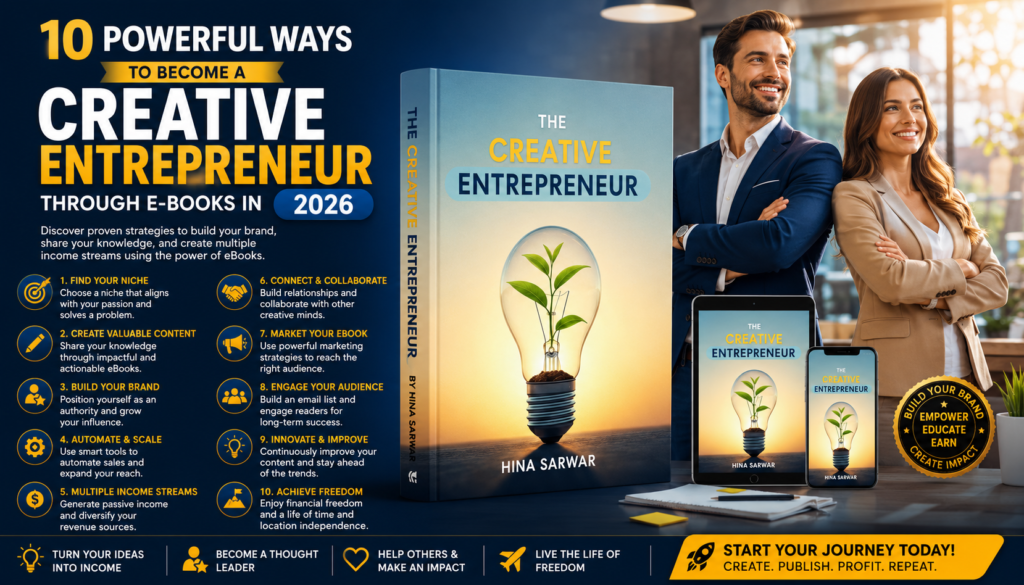
Introduction: Why Every Indian Should Become a Creative Entrepreneur in 2026

The year 2026 has brought an extraordinary opportunity for every Indian who has knowledge, skills, or stories to share. The digital revolution has made it possible for anyone to become a creative entrepreneur without needing a publisher, a big budget, or years of experience. The global e-book market has reached an impressive $18.13 billion, and India’s self-publishing industry has grown by 264% in just five years. This massive growth means that now is the perfect time to enter this field. Amazon now allows self-publishing in five Indian languages including Hindi, Tamil, Marathi, Gujarati, and Malayalam, opening doors for millions of Indians who prefer reading in their mother tongue. Artificial intelligence tools have reduced the cost and time of creating e-books by over 95%, making it possible to create a professional-quality book in days rather than months. Whether you are a college student looking for pocket money, a teacher wanting to build a side income, a homemaker with expertise to share, or a professional seeking to monetize your skills, you can become a successful creative entrepreneur. The success stories from India are truly inspiring, from Ankur Warikoo who sold over one million books without technically writing any of them from scratch, to Amish Tripathi who overcame 20 rejections to become a bestselling author through self-publishing. These examples prove that with the right strategy and mindset, anyone can succeed as a creative entrepreneur. In this comprehensive guide, we will share ten powerful ways to build your e-book business in India, with practical steps you can take starting today to begin your journey toward financial independence and creative fulfillment.
Point 1: Find Your Profitable Niche as a Creative Entrepreneur


The very first step toward becoming a successful creative entrepreneur is choosing the right topic or niche for your e-book. This decision is extremely important because it determines whether people will actually buy your book. Many new authors make a common mistake by writing about something they personally love, without checking if there is any real demand in the market. This approach often leads to disappointment when the book fails to sell. A smart creative entrepreneur understands that the best topic is where your knowledge or passion meets what people are actually willing to pay money to learn. To find this sweet spot, you need to do some basic research. Start by thinking about what you know well, which could be related to your job, your hobby, a skill you have developed over the years, or even a challenge you have overcome in your life. This personal experience gives you unique insights that readers cannot find anywhere else. Then you need to validate whether people are interested in this topic by searching on Amazon Kindle to see what books are already selling in that area. Look at the reviews of those books carefully because they tell you exactly what readers like and what they complain about, which gives you valuable information about how to make your book better. Pay attention to social media conversations as well, because people often discuss their problems and questions on platforms like Facebook, Instagram, and Reddit. The top-selling niches in 2026 for a creative entrepreneur include artificial intelligence and productivity guides, personal finance and budgeting books, health and fitness programs, self-help and personal development content, and practical guides that solve specific problems. For example, if you are a graphic designer from Pune, you could create an e-book teaching others how to use design tools effectively. This targeted approach is what separates successful creative entrepreneurs from those who struggle to make sales. Take action today by spending one hour researching on Amazon to find three niches that interest you, and check if there are at least twenty books in each niche to confirm there is genuine demand. This simple research will set you on the path to becoming a successful creative entrepreneur.
Point 2: Validate Your E-book Idea Before Writing Anything


Many aspiring creative entrepreneurs make the painful mistake of spending months writing an entire book, only to discover later that nobody actually wants to read it or buy it. This frustrating experience can be completely avoided by validating your idea before you invest significant time and energy into writing. Validation simply means checking whether people are genuinely interested in your topic and whether they would be willing to pay money to learn from you. Smart creative entrepreneurs understand that this step is not optional but essential for success. There are several simple and effective ways to validate your e-book idea without spending any money. You can start by asking questions in Facebook groups and Reddit communities that are related to your topic, because these platforms have active communities of people who share similar interests and problems. For instance, if you are planning to write a book about budget cooking, join cooking groups and ask members what their biggest challenges are when trying to cook on a tight budget. Their answers will give you perfect ideas for your book content. You can also run a simple poll on Instagram or LinkedIn by asking your followers whether they would buy an e-book about your chosen topic, and what specific questions they would want answered. This direct feedback from real people is incredibly valuable for a creative entrepreneur because it comes straight from potential customers. Additionally, you can check Google search volume using free tools to see how many people are actively searching for information related to your topic, because high search volume indicates strong demand. Amazon bestseller rankings in your niche also provide important clues, because if similar books are selling well, there is a proven market waiting for you. Some creative entrepreneurs even create a simple landing page with a waitlist to measure interest before writing a single word of their book. The difference between unsuccessful and successful creative entrepreneurs often comes down to this validation step. For example, Radhika Mishra, a thirteen-year-old girl from Rewa, wrote three e-books and achieved literary success because she understood what young readers wanted to learn. She became a young creative entrepreneur by carefully listening to her audience before she started writing. Take action today by posting this question in a relevant Facebook group: “Would you buy an e-book that teaches [your topic], and what specific questions would you want answered?” The responses you receive will guide your content creation and ensure you become a successful creative entrepreneur.
Point 3: Leverage AI Tools to Write Faster and Better

The year 2026 has brought a revolutionary change to the world of e-book creation, and artificial intelligence is at the heart of this transformation. What used to take three months for a creative entrepreneur to write can now be completed in just a few days, thanks to powerful AI tools that are readily available and surprisingly affordable. The best part is that AI does not replace your creativity or expertise, but rather enhances your abilities by handling the time-consuming aspects of writing. A smart creative entrepreneur views AI as a collaborative partner that helps turn ideas into polished books much faster than ever before possible. There are several excellent AI tools available in 2026 that every creative entrepreneur should know about. ChatGPT Plus costs only twenty dollars per month and is excellent for brainstorming ideas and generating initial drafts of content. Claude, another powerful AI tool, can be used for free or with a premium subscription, and it excels at creating well-structured content that requires minimal editing. BookCraft AI is an India-first platform with localized pricing at just four hundred ninety-nine rupees per month, and it uses Gemini technology to generate intelligent book outlines and market analysis specifically for the Indian audience. Canva, which is available for free or with a premium subscription at thirteen dollars per month, helps creative entrepreneurs create professional covers and graphics without needing to hire a designer. Midjourney can generate stunning and unique cover images that grab readers’ attention immediately. To use these tools effectively, a creative entrepreneur should start by using AI to research the best topics and keywords in their niche, then ask the AI to help create a clear chapter structure that flows logically. The AI can generate a first draft based on your outline, but you must always add your unique voice, personal experiences, and insights to make the book authentically yours. Use AI tools for checking grammar and improving the overall flow of your writing, and leverage them to create professional covers without needing design skills. A real-world example of this approach is BookCraft AI, which has created over seventy-seven thousand books across two hundred sixteen countries, and India accounts for ten point two percent of all AI-generated books globally. This shows that Indian creative entrepreneurs are already embracing AI technology to accelerate their success. Take action today by opening ChatGPT or Claude and asking it to create an outline for your e-book idea, and experience firsthand how much time you can save as a modern creative entrepreneur.
Point 4: Design a Professional E-book Cover Without Hiring a Designer

The cover of your e-book is the very first thing that potential readers see, and it plays a crucial role in determining whether they will click to learn more or scroll past your book without a second glance. A professional-looking cover builds trust and signals quality, while an amateurish cover makes readers assume the content inside is equally poor. As a creative entrepreneur, you need to understand that readers truly do judge a book by its cover, especially in the crowded e-book marketplace where thousands of new titles are published every single day. The encouraging news is that you do not need to spend thousands of rupees hiring a professional designer to create an attractive cover. There are excellent tools available in 2026 that enable any creative entrepreneur to design stunning covers quickly and completely free of charge. Canva is perhaps the most popular tool among creative entrepreneurs because it offers hundreds of professionally designed e-book cover templates that you can customize with your title and author name in just a few clicks. The platform is incredibly easy to use and requires no prior design experience whatsoever. For those who want more unique or artistic covers, Midjourney uses artificial intelligence to generate original images based on your description, creating covers that are truly one-of-a-kind and impossible for anyone else to replicate. BookCraft AI includes automatic cover generation as part of its service, saving you even more time and effort. Adobe Express is another excellent free option with many templates and design tools suitable for creative entrepreneurs. When designing your cover, remember these essential tips that successful creative entrepreneurs follow: keep the design simple and clean because too much clutter confuses readers and makes your book look unprofessional. Use high-contrast colors that make your title stand out, because your title should be readable even when the cover appears as a small thumbnail on a mobile phone screen. Make your title big and bold so readers immediately understand what your book is about without having to squint. Make sure your cover matches the genre expectations, because a romance cover should look different from a business book cover. Before finalizing your cover, show it to at least five friends and ask them honestly whether they would click on it if they saw it on Amazon. A practical example is a student from Jaipur who makes eight hundred dollars per month writing SEO content and creates simple but effective covers using Canva for his clients. He became a successful creative entrepreneur by understanding that professional design does not require a professional budget. Take action today by visiting Canva, searching for e-book cover templates, selecting one that matches your topic, customizing it with your title and author name, and downloading your professional cover completely free of charge.
Point 5: Format Your E-book Professionally for All Devices

Proper formatting is essential because it determines how your e-book appears on different devices that readers might use, including smartphones, tablets, and dedicated e-readers like Kindle. Poor formatting can make your book look messy and unprofessional, which frustrates readers and leads to negative reviews. Good formatting, on the other hand, ensures that readers enjoy a smooth and pleasant reading experience that keeps them engaged from the first page to the last. As a creative entrepreneur, you want every reader to have a positive experience because happy readers leave glowing reviews, and glowing reviews lead to more sales and better visibility on platforms like Amazon. Fortunately, formatting your e-book professionally has become extremely easy in 2026, with several excellent tools available for creative entrepreneurs of all skill levels. Kindle Create is a completely free tool provided by Amazon that makes formatting simple and straightforward, even for beginners who have never formatted a book before. The tool automatically creates a table of contents, adjusts for different screen sizes, and ensures your book looks great on any device. Atticus is a paid formatting tool that offers professional-quality results with many customization options for creative entrepreneurs who want more control over their book’s appearance. Vellum is another high-quality formatting tool, though it is currently only available for Mac users. BookCraft AI includes automatic formatting as part of its service, saving you even more time. You can also use Google Docs to export your manuscript as an EPUB or PDF file, which works well for direct sales to your audience. When formatting your book, successful creative entrepreneurs follow these important tips: use clear headings and subheadings to organize your content logically, because this helps readers navigate your book easily. Add a working table of contents that links to each chapter so readers can jump directly to the sections that interest them most. Use bullet points and numbered lists to break down complex information into digestible pieces. Include images where they add value and help explain concepts more clearly than words alone. Always test your formatted book on different devices before publishing to ensure everything looks correct. The standard for e-books in 2026 is the EPUB format, which works on most platforms and devices. PDF files work well for direct sales but are not ideal for Amazon publishing. Take action today by downloading Kindle Create, uploading your manuscript, and seeing how simple it is to format your book professionally, because every creative entrepreneur should master this fundamental skill.
Point 6: Choose the Right Publishing Platforms for Your E-book

Once your e-book is written, designed, and formatted, you need to decide where to publish it for maximum reach and profitability. There are several excellent platforms available in 2026, and the right choice depends on your specific goals, target audience, and marketing strategy. A successful creative entrepreneur often publishes on multiple platforms to maximize visibility and revenue, but it is wise to start with the most suitable option and expand gradually. Amazon Kindle Direct Publishing, commonly known as KDP, is the largest and most popular platform for creative entrepreneurs because it reaches over two hundred million readers worldwide and offers royalties ranging from thirty-five to seventy percent. KDP is particularly attractive for Indian creative entrepreneurs because it now supports self-publishing in Hindi, Tamil, Marathi, Gujarati, and Malayalam, making it accessible to a much wider audience. Notion Press is an India-based publishing platform that has grown significantly and is now targeting revenues of over one hundred crore rupees this financial year, making it a practical alternative for Indian authors. Gumroad is excellent for creative entrepreneurs who already have an existing audience, because it allows direct sales without giving up a large percentage of your revenue, charging only a ten percent fee. Etsy is perfect for niche practical guides, planners, and templates, and it has over ninety million active buyers looking for digital products, with profit margins reaching as high as eighty-five to ninety-five percent. Google Play Books provides another distribution channel that reaches Android users across the globe. When selecting platforms, creative entrepreneurs should carefully compare royalty rates and understand that Amazon pays seventy percent royalty for books priced between ninety-nine rupees and two thousand four hundred ninety-nine rupees. Consider enrolling your book in Kindle Unlimited through KDP Select, which allows you to earn money from pages read in addition to traditional sales, creating a second income stream. Think about your target audience’s preferences and habits, because readers in different regions often prefer different platforms. A practical example is Chennai-based Notion Press, which is helping many Indian creative entrepreneurs publish their books successfully and reach readers across the country. Take action today by creating an Amazon KDP account, which is completely free, even if you are not ready to publish anything yet, because having your account set up removes one barrier to taking action when you are ready to become a published creative entrepreneur.
Point 7: Market Your E-book Effectively to Reach More Readers

Publishing your e-book is only the beginning of your journey as a creative entrepreneur. The hard truth that many new authors discover is that simply publishing a book on Amazon does not guarantee sales or readers. You need to actively market your book to reach your target audience and generate the sales that will make your efforts worthwhile. Successful creative entrepreneurs understand that marketing is not optional but absolutely essential for building a sustainable e-book business. The good news is that effective marketing does not require a huge budget, and there are many strategies that produce excellent results at little or no cost. Video marketing has become one of the most powerful tools available to creative entrepreneurs in 2026, with video content consumption increasing by over fifty percent year-over-year. You can create short videos about your book topic and post them on Instagram Reels, YouTube Shorts, and TikTok to reach millions of potential readers. Social media platforms like Facebook, Instagram, LinkedIn, and Twitter allow you to share snippets from your book, ask thought-provoking questions, and build a community around your topic. Building an email list is perhaps the most valuable long-term investment a creative entrepreneur can make, because this audience belongs to you and cannot be taken away by algorithm changes on social media platforms. Similarly, creating WhatsApp and Telegram communities allows you to connect directly with your readers in a more personal way. Amazon Advertising can be started with a small budget of just five hundred rupees per day, allowing you to test what works and scale up gradually based on results. Kindle Unlimited provides an additional revenue stream through page reads, and running free Kindle promotions or low-price deals initially can help you get reviews and climb bestseller lists. Many creative entrepreneurs have found success through organic growth strategies. For example, Aman Jain built a readership of over four point six crore readers through self-driven distribution and digital platforms, proving that consistent effort produces remarkable results. Take action today by choosing one marketing strategy from this list and implementing it immediately, such as creating a thirty-second video about your book topic and posting it on Instagram, because this is exactly how successful creative entrepreneurs begin building their audience.
Point 8: Build a Series of Books and Create Valuable Bundles

Successful creative entrepreneurs understand that publishing a single book is just the beginning of their journey, not the destination. Building a series of books and creating bundles is one of the most effective ways to increase your income and build reader loyalty over time. When readers enjoy your first book, they naturally want more content from you, and a well-planned series satisfies this demand while generating multiple income streams. Each new book in your series promotes all your previous books, creating a snowball effect that grows your visibility and sales with every release. As you publish more books, you establish yourself as an expert in your niche, which increases reader trust and willingness to purchase your future works. A carefully designed series also creates a steady stream of income because loyal readers will buy each new book as soon as it becomes available. For example, if you are a creative entrepreneur who writes about artificial intelligence, you could structure your series with Book One covering AI for Beginners, Book Two focusing on AI for Content Creators, Book Three addressing AI for Business Owners, and Book Four tailored for Students. This logical progression makes it easy for readers to start with the beginner book and continue through the series as their knowledge grows. Creating bundles of your books at a discounted price encourages readers to purchase multiple books at once, increasing your average order value and reducing marketing costs per sale. Bundles also make readers feel they are getting excellent value, which builds goodwill and encourages them to recommend your books to others. When you offer a bundle of all three books at a price that saves readers money compared to buying them individually, you create a compelling offer that is hard to refuse. A real-world example is Prapthi Gowda, a twenty-two-year-old from Dakshina Kannada who published her first book in the Arebhashe language, and she can now build on this achievement by writing more books in the same language, gradually becoming a recognized creative entrepreneur in her regional language market. Take action today by starting to plan your second book immediately after publishing your first book, thinking carefully about what your readers would naturally want to learn next, because this long-term strategic thinking is what separates truly successful creative entrepreneurs from those who give up after one book.
Point 9: Write in Regional Languages to Reduce Competition and Reach More Readers

Most creative entrepreneurs instinctively choose to write in English because it is considered the global language of business and has the largest potential audience. However, this choice also means facing intense competition from millions of other books published in English every year. A smart creative entrepreneur considers writing in regional languages as a strategic advantage because there is significantly less competition and a hungry audience waiting for quality content in their mother tongue. India is home to twenty-two official languages, and the regional book market serves over four hundred ninety-three million people who prefer reading in their native language. Amazon has recognized this massive opportunity and now allows self-publishing in Hindi, Tamil, Marathi, Gujarati, and Malayalam, making it easier than ever for creative entrepreneurs to reach regional language readers. The Hindi language book market is particularly promising, with Hindi accounting for twenty-six percent of all books published in India, representing over twenty-three thousand titles published every year. Tamil, Marathi, Gujarati, and Malayalam are also growing markets with loyal readers who deeply appreciate content in their language. The competition in regional languages is much lower than in English, meaning your book has a better chance of being discovered and climbing bestseller lists. Readers also show higher loyalty to authors who write in their regional language, often becoming devoted fans who buy every book you publish. Many creative entrepreneurs have already found success by focusing on regional language content, such as those selling Marathi recipe e-books and other niche digital products. To succeed as a regional language creative entrepreneur, you should ensure your writing is authentic and culturally relevant to your target audience. Consider starting with the most popular regional language in your area and expanding to other languages as you gain experience and confidence. Take action today by evaluating whether you are fluent enough in any regional language to write a book in that language, because you may find a more receptive and less competitive audience than you would face in the crowded English market.
Point 10: Study and Learn from Inspiring Indian Success Stories

The most effective way to accelerate your journey as a creative entrepreneur is to study the success stories of people who have already achieved what you are trying to accomplish. India is filled with inspiring examples of individuals who turned their knowledge and creativity into successful e-book businesses against all odds. Ankur Warikoo is perhaps the most remarkable example, having sold over one million books and earned four point five crore rupees in royalties, all without technically writing any of his books from scratch. He built his books from existing content including videos, social media posts, and talks, proving that you do not need to start from a blank page to become a successful creative entrepreneur. Amish Tripathi faced rejection from more than twenty publishers for his book The Immortals of Meluha before deciding to self-publish it, and he eventually sold over eighty lakh copies, demonstrating that persistence and self-belief are essential qualities for any aspiring creative entrepreneur. Savi Sharma self-published her first book at just twenty-three years old and sold one lakh copies within one hundred days, proving that age is absolutely not a barrier to success. Radhika Mishra, a thirteen-year-old girl from Rewa, wrote three e-books and achieved literary success, showing that you can start your journey at any age. Pranav Shashibhushan Bayari, a fifteen-year-old from Belagavi, wrote a four hundred sixty-page suspense novel during Class nine, balancing his academics with his creative passion, which demonstrates remarkable discipline and focus. Aman Jain built a readership of over four point six crore people through self-driven distribution and digital platforms, proving that organic growth through consistent effort produces extraordinary results. These success stories teach every creative entrepreneur several valuable lessons: you do not need permission from anyone to become an author, age is not a limiting factor, you can repurpose what you already know into valuable content, self-publishing works when you do it properly, and consistency and marketing effort matter more than luck. Take action today by selecting one of these inspiring success stories and researching their journey in more detail, identifying one specific strategy they used that you can apply to your own e-book project, because learning from those who have already succeeded is the most efficient path to becoming a successful creative entrepreneur yourself.
Conclusion: Your Journey as a Creative Entrepreneur Begins Today


Becoming a successful creative entrepreneur through e-books in 2026 is one of the most exciting and achievable opportunities available in India today. The market is growing at an unprecedented rate, the tools are more affordable and accessible than ever before, the platforms are designed to help independent authors succeed, and the inspiring success stories from India prove that anyone with determination and the right strategy can achieve remarkable results. Throughout this comprehensive guide, we have covered ten powerful ways to build your e-book business, from finding your profitable niche and validating your idea, to leveraging AI tools and designing professional covers, from formatting your book properly and choosing the right publishing platforms, to marketing effectively and building series, from considering regional languages and studying Indian success stories to taking consistent action every single day. The key takeaway that every creative entrepreneur should remember is that your first e-book does not need to be perfect, it simply needs to exist so that you can improve, update, and iterate based on feedback and experience. The most important step is to start, because action creates momentum and momentum creates success. The tools are available to help you, the platforms are ready to showcase your work, and the readers are waiting for valuable content that solves their problems or enriches their lives. The only question that remains is whether you will take the first step today and begin your journey as a creative entrepreneur, because the best time to start was yesterday and the next best time is right now.